Introduction
For Australians travelling to Thailand, getting a local SIM card is one of the most practical things you can organise before leaving the arrivals hall. Mobile data in Thailand is affordable, and coverage across tourist areas is reliable — but there are several different places to buy a SIM, and not all offer the same experience.
The three most common options are airport kiosks, 7-Eleven and other convenience stores, and official carrier stores in shopping centres and city areas. All three options work. The difference comes down to price, convenience, the level of support you receive, and when during your trip you choose to buy.
This guide explains each option clearly so you can decide what suits your situation before you arrive.
Quick Decision Shortcut
Choose an Airport SIM if:
- You want to be connected as soon as you clear customs
- You’re arriving late at night or early in the morning
- You’d rather have staff insert and test the SIM for you
- You’re not planning to visit a shopping centre early in your trip
- Convenience matters more than saving a small amount of money
Choose a 7-Eleven SIM if:
- You’re comfortable following basic setup instructions
- You’d prefer to pay slightly less than airport prices
- You’re happy to buy a SIM after settling in
- You’re already near a 7-Eleven during your first day
Choose a Carrier Store if:
- You’re staying in Thailand for two weeks or longer
- You want detailed assistance and access to a wider range of plans
- You’d like to ask questions about coverage, top-ups, and data allowances in person
- You have a specific requirement, such as calls included or a longer validity period
What Is an Airport SIM?
Airport SIM kiosks are located inside the arrivals halls of Thailand’s major international airports, including Suvarnabhumi and Don Mueang in Bangkok, Phuket International, and Chiang Mai International. You’ll typically find them shortly after clearing immigration and collecting your luggage.
Staff register your SIM using your passport — this is a legal requirement in Thailand — and will usually insert the card into your phone and confirm it’s working before you leave. Tourist plans are clearly displayed, and the process is generally quick.
Pros
- Available immediately after landing
- Staff insert and activate the SIM for you
- English-speaking support in major airports
- No need to travel elsewhere before getting connected
- Straightforward, assisted setup
Cons
- Prices are usually slightly higher than in-city options
- Plan selection may be limited to standard tourist bundles
- Queues can form at peak arrival times
- You are making a quick decision while tired from travel
What Is Buying a SIM at 7-Eleven?
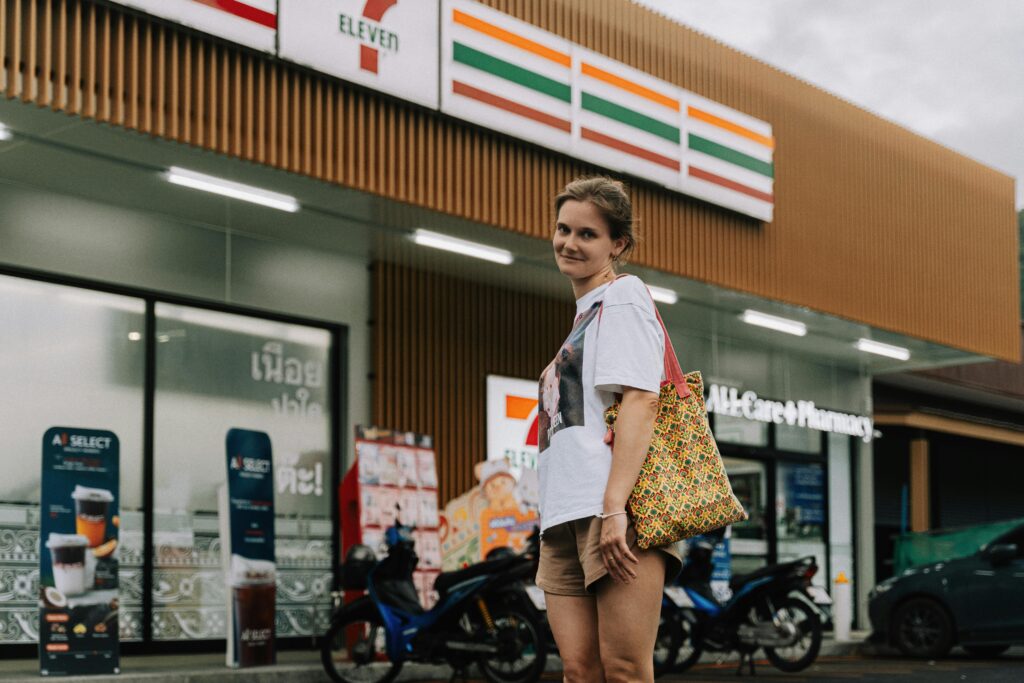
Thailand has a large number of 7-Eleven stores, found in cities, tourist areas, and many regional towns. Many branches stock prepaid SIM cards and top-up vouchers.
The experience can vary. Some stores will help with registration and activation. Others may sell the SIM as a package and expect you to complete registration yourself, often by scanning a QR code or following printed instructions. In smaller or less tourist-focused areas, instructions may primarily be in Thai.
Pros
- Often slightly cheaper than airport kiosks
- Available almost everywhere, including 24 hours
- Convenient if you prefer to organise your SIM after settling in
- Easy access to top-ups during your stay
Cons
- Setup assistance varies between stores
- English support may be limited outside major tourist areas
- You may need to complete activation yourself
- Not ideal if you require data immediately upon arrival
What Is a Carrier Store?
Carrier stores are official retail outlets operated by Thailand’s mobile networks. They are typically located in shopping centres, department stores, and city centres.
These stores offer the most comprehensive service. Staff can assist with plan selection, SIM setup, troubleshooting, and top-ups. In major tourist and expat areas, English support is generally reliable.
Pros
- Widest range of plans, including longer-term options
- Detailed assistance and troubleshooting support
- Helpful for extended stays or higher data needs
- Direct access to the network provider
Cons
- Requires a separate visit once you are in the city
- May involve waiting during busy periods
- Less convenient for short stays needing only a basic plan
- Limited to shopping centre business hours
Key Differences That Matter for Australians
Price Differences
Airport kiosks typically charge a modest premium for convenience. The difference is usually small for short tourist plans, but more noticeable on larger or longer-validity plans.
7-Eleven and carrier stores generally reflect standard city pricing. The trade-off is that setup assistance may vary, particularly at convenience stores.
Setup and Assistance
Airport kiosks provide the most assisted experience, with staff handling registration, insertion, and testing.
At 7-Eleven, support depends on the individual store. Some staff are experienced with tourist SIMs; others may simply provide instructions.
Carrier stores offer the most thorough support and are best suited to travellers who want advice, troubleshooting, or plan flexibility.
Time and Convenience
Airport kiosks allow you to leave the terminal already connected. This can simplify transport arrangements and navigation.
7-Eleven purchases require waiting until you reach your accommodation area but are convenient once you are settled.
Carrier stores require a deliberate visit during business hours and suit travellers with a flexible schedule.
English Support
English assistance is generally reliable at airport kiosks and carrier stores in major cities.
At 7-Eleven, English proficiency varies. In tourist centres it is usually adequate for a simple SIM purchase, but detailed questions may be more difficult in smaller towns.
Which Option Suits Different Types of Australian Travellers?
Short Holidays (Under 10 Days)
Airport kiosks are often the simplest option, especially if you want immediate connectivity. 7-Eleven works well if you are comfortable waiting a few hours.
Carrier stores are rarely necessary for a short stay.
2–3 Week Trips
Both airport and 7-Eleven options are suitable. A carrier store visit may be worthwhile if you expect high data usage or want more flexibility.
Longer Stays (30+ Days)
Carrier stores are generally the most appropriate starting point for extended stays, as they offer access to standard prepaid plans and longer validity options.
Non-Tech-Confident Travellers
Airport kiosks provide the most straightforward experience, with full assistance from staff. Carrier stores also offer strong support but require a separate visit.
Late Night Arrivals
Airport kiosks are usually the most practical option if you land late. Carrier stores will be closed, and while 7-Eleven may be open, setup support may be limited.
Budget-Focused Travellers
7-Eleven and carrier stores generally offer slightly better value than airport kiosks for comparable plans. The difference is modest for short stays but may matter more for longer trips.
Common Mistakes Australians Make
- Waiting too long to buy a SIM and relying on expensive roaming
- Choosing a validity period shorter than the trip
- Forgetting to carry a passport for registration
- Assuming all convenience stores will activate the SIM
- Not confirming that the phone is unlocked
- Discarding SIM packaging that contains important details
FAQs
Is the airport SIM much more expensive?
Not significantly. The premium reflects convenience rather than a large price difference.
Can I switch later?
Yes. You can purchase a new SIM or change plans during your stay if needed.
Can I top up easily?
Yes. Top-ups are widely available at convenience stores and carrier shops.
Do I need my passport?
Yes. Thai regulations require passport registration for SIM purchases.
What if my SIM stops working?
Restart your phone first. If the issue continues, visit a carrier store for assistance.
Can I buy at the airport and change later?
Yes. Some travellers start with an airport SIM and later switch to a different plan.
Is one network better in cities versus islands?
Coverage varies slightly by region, but all major Thai networks focus on cities and popular tourist areas. For most travellers, the purchase location is more important than the specific brand.
Final Summary + What Australians Should Do Before Flying
All three options — airport kiosk, 7-Eleven, and carrier store — are practical choices for Australians travelling to Thailand. The right one depends on when you want to be connected, how much assistance you prefer, and how long you are staying.
Before you fly:
- Confirm your phone is unlocked.
- Decide whether convenience or price is your priority.
- Match your SIM validity to your full trip length.
- Keep your passport accessible on arrival.
- Remember that there is no single “perfect” choice — all three options work well.
Related Guides
- Thailand eSIM vs Physical SIM
- Best SIM Card for Thailand (2026 Comparison)
- How Much Data Do You Need in Thailand?