Introduction
If you’re an Australian heading to Thailand and you’re not sure what to do about your phone, you’re in the right place. Mobile data in Thailand is affordable and widely available — but it can feel confusing if you’ve never bought a local SIM card before.
This guide explains your options clearly and without jargon. It covers where to buy a SIM card when you land, how to set it up, what mistakes to avoid, and how to decide between a physical SIM and an eSIM.
Quick decision shortcut:
- If your phone supports eSIM and you’re comfortable with a QR-code setup, buying an eSIM before you fly is usually the simplest option.
- If not, buying a tourist SIM at the airport on arrival is fast, easy, and works perfectly well.
Do Australians Need a SIM Card in Thailand?
In most cases, yes — getting a local Thai SIM card is the most practical option for Australians travelling to Thailand.
Here’s why:
- Australian roaming plans are expensive. Most Australian carriers charge significantly more for overseas data than what you’d pay for a local Thai SIM.
- Coverage from a local SIM is reliable. Thailand has well-developed mobile infrastructure, particularly in Bangkok, Chiang Mai, Phuket, Koh Samui and other major tourist areas.
- Local SIM cards are easy to buy. You can pick one up at the airport within minutes of landing, or at thousands of convenience stores across the country.
The only situation where a local SIM might not be necessary is if you’re in Thailand for one or two days and your Australian plan includes reasonable roaming. Otherwise, a local SIM almost always makes more financial sense.
Physical SIM vs eSIM in Thailand (For Australians)
Before buying anything, it helps to understand the two formats available.
Physical SIM Card
A physical SIM is a small card that slots into your phone. You remove your existing Australian SIM and replace it with the Thai one.
Pros:
- Available everywhere — airports, 7-Elevens, carrier stores
- Works in virtually any unlocked phone
- Easy to understand for non-tech users
- Can be topped up at convenience stores across Thailand
Cons:
- You’ll need to store your Australian SIM safely
- Small risk of losing the card
- Requires your phone to be unlocked
eSIM
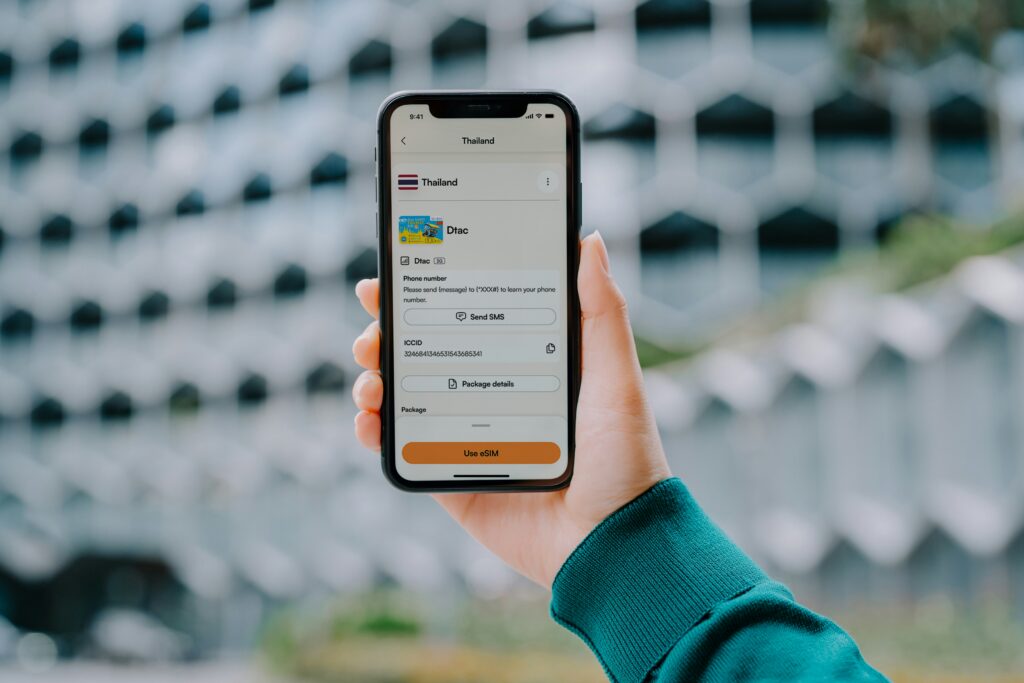
An eSIM is a digital SIM built into your phone. You scan a QR code and the plan is activated without swapping any physical card.
Pros:
- No physical card to manage
- You can often keep your Australian number active at the same time
- Can be purchased and installed before you leave Australia
Cons:
- Not all phones support eSIM
- Slightly more technical to set up
- Usually requires Wi-Fi for activation
If you’re arriving late or want the simplest arrival experience, install the eSIM at home and switch it on after landing.
Which should Australians choose?
If your phone supports eSIM and you’re comfortable following basic instructions, an eSIM purchased before departure is convenient. If you’d rather keep things simple and don’t mind swapping a SIM card, a physical SIM bought at the airport works perfectly well.
Where Australians Can Buy a Thailand SIM Card
Airport Kiosks
All major Thai airports — including Suvarnabhumi (Bangkok), Don Mueang (Bangkok), Phuket International and Chiang Mai International — have SIM card kiosks in arrivals.
What to know:
- Prices are slightly higher than in town
- Staff are used to tourists
- You’ll need your passport (legal requirement)
- SIMs are usually activated on the spot
For most travellers, the convenience outweighs the small price difference.
7-Eleven and Convenience Stores
Thailand has thousands of 7-Eleven stores, many of which sell prepaid SIM cards.
What to know:
- Often cheaper than airport kiosks
- May require basic self-activation
- English support varies by store
- Open 24 hours
Mobile Carrier Stores
Carrier stores in shopping centres offer the most assistance and plan flexibility.
What to know:
- Better for longer stays
- Staff in tourist areas usually speak English
- Expect to wait during busy periods
- Passport required
Buying Before Departure
You can buy a Thai SIM or eSIM online before leaving Australia.
What to know:
- Physical SIMs can be mailed to your home
- eSIMs can be installed before departure
- Removes airport hassle
- Compare validity and data allowances carefully
Major Mobile Networks in Thailand (Neutral Overview)
Thailand has three primary mobile networks. All offer tourist-friendly prepaid plans.
Coverage Reliability
All major networks provide solid coverage in cities, tourist areas, and along major highways. If you’re staying in common tourist corridors — Bangkok, Phuket, Chiang Mai, Krabi, Koh Samui — any major network will work well. In remote islands or rural mountain areas, coverage can vary.
For most Australian visitors, plan validity and data allowance matter more than the specific network name.
Tourist Plan Types
Most networks offer prepaid tourist SIMs that include:
- A set data allowance
- A fixed validity period (commonly 7, 15, or 30 days)
- Sometimes limited local calls
Speed Expectations
4G is widely available and more than sufficient for maps, streaming, video calls and general browsing.
5G is available in many major Thai cities and some tourist areas, but you will still fall back to 4G in plenty of locations — and for most travellers, 4G is perfectly adequate.
Best SIM Card Options for Thailand (2026 Comparison)
The right SIM depends on trip length and data use. Specific plans change regularly, so use this framework when choosing.
Short Trips (Under 10 Days)
A 7-day tourist SIM is usually suitable.
Look for:
- 15–30GB of data or an unlimited plan with fair-use speeds
- Validity covering your full stay
- Activation on arrival
Avoid buying a 7-day SIM on day two of a 9-day trip.
2–3 Week Holidays
A 15-day or 30-day plan usually offers better value.
Consider:
- Whether “unlimited” plans throttle speeds after daily limits
- When validity begins (activation vs purchase date)
- Buying at the airport so you don’t lose days
Longer Stays (30+ Days)
For longer stays:
- Visit a carrier store for prepaid plans with renewable data
- Ask about monthly data add-ons
- Consider eSIM if you want to keep your Australian SIM active
How Much Data Do Most Australians Use?
As a rough guide:
- Light use (maps + messaging): 1–2GB per day
- Normal use (maps + social + browsing): 2–4GB per day
- Heavy use (streaming, hotspot, video calls): 5GB+ per day
Buying slightly more data than you expect to need is usually sensible.
How Australians Activate a Thailand SIM Card
Passport Requirement
Thai law requires SIM registration. You must show your passport when purchasing.
APN Setup
Most tourist SIMs are pre-configured.
If data doesn’t work:
- Go to Settings
- Open Mobile Data / Cellular
- Check APN settings
- Enter details from SIM packaging if needed
Restarting the phone resolves most issues.
Data Activation
Data usually activates automatically within minutes.
If not:
- Restart the phone
- Check mobile data is switched on
- Confirm you are not on Wi-Fi only mode
Troubleshooting Basics
- No signal: Check SIM placement and confirm phone is unlocked
- Signal but no data: Check APN settings
- Slow speeds: You may have exceeded a daily fair-use cap
- No calls: Many tourist SIMs are data-only — use messaging apps
Common SIM Mistakes Australians Make in Thailand
Buying the Wrong Validity
Match the plan to your full trip length.
Not Checking Phone Compatibility
If your phone was purchased on a Telstra, Optus or Vodafone plan, confirm it is unlocked before departure.
Running Out of Data
Maps, ride apps and video calls consume more data than expected. Top-ups are widely available.
Overpaying at Airport Kiosks
Airport kiosks are convenient but not always cheapest. Decide whether convenience or saving a small amount matters more.
Assuming Your Phone Will Automatically Work
Without a local SIM or roaming activated, you may have no data or incur unexpected charges.
Using Australian Roaming vs Local Thailand SIM
Australian roaming may suit you if:
- Your plan includes international data
- You’re visiting for only one or two days
- You must stay reachable on your +61 number
A local Thai SIM is usually better if:
- You’re staying longer than two or three days
- Your plan charges daily roaming fees
- You want predictable costs and higher data allowances
For most leisure trips, a local SIM offers better value.
FAQs
Can I keep my Australian number?
If you swap to a physical Thai SIM, your Australian SIM is inactive while removed. With eSIM (dual SIM setup), you can often keep your Australian number active.
Will WhatsApp still work?
Yes. WhatsApp works via internet and remains linked to your Australian number.
Is 5G available?
Yes in many cities and some tourist areas, but 4G is more common and perfectly adequate.
Do I need to unlock my phone?
Yes, if it is carrier-locked. Contact your Australian carrier before travelling.
Can I top up easily?
Yes. Top-ups are available at convenience stores and carrier outlets across Thailand.
What if my SIM stops working?
Restart your phone first. If that doesn’t fix it, visit a carrier store in a shopping centre — English-speaking assistance is common in tourist areas.
Do I need Wi-Fi to activate an eSIM?
Yes, in most cases. Install and set up the eSIM before departure for the simplest experience.
Final Summary + What Australians Should Do Before Flying
Before you leave Australia:
- Confirm your phone is unlocked.
- Decide between physical SIM and eSIM.
- Choose a plan covering your full stay.
- Estimate your likely data use.
- Check your Australian roaming costs.
- Carry your passport for SIM registration.
- Keep your SIM packaging for top-up details.
Sorting your mobile data before or immediately after landing makes your Thailand trip significantly easier. With a local SIM in place, you’ll have reliable maps, transport apps, messaging and internet access from the moment you clear customs.
Next useful guides:
- Thailand eSIM vs Physical SIM: What Australians Should Choose in 2026
- Thailand Airport SIM vs 7-Eleven vs Carrier Store: Where Australians Should Buy in 2026
- Money & ATMs in Thailand for Australians
This guide reflects general conditions in 2026. Plan details, pricing and coverage change regularly. Always verify current options before purchasing.